SPOTLIGHT is a new feature which, periodically, will present one or more works by a contemporary or historical artist whose art I admire or find interesting.
Featured in this first Spotlight, S.W. Austin is a Canadian artist whose work I have long admired since first happening upon it in Toronto some years ago. His work was featured in three group shows and two solo shows at my gallery GNSTUDIO Contemporary Art and there are two essays on his work in this blog.
Originally based in Toronto, and Hamilton, Ontario, Austin now lives in Nova Scotia, Canada in a somewhat remote rural area of great beauty near the Bay of Fundy. There is an echo of late Pollock in his desire to push at the parameters of Painting away from the literal and cultural noise of the city.
Like Pollock, Austin’s studio is a barn-like building set in wooded acres adjacent to his house. An artist carries within themselves a personal history of experiences, memories, understandings and aims yet this core is rarely static as new experiences, contexts and places build upon that history and exert an influence.
Austin’s approach to making art continues to embrace three key elements: an exploration of that subjective deep well that we might call the imaginative psyche; the conviction that, to paint seriously is to interrogate the parameters of what Painting as an art form might be; and thirdly, his understanding that the constituent materiality of a painting and the language of its utilization is fundamental to its very being. These three elements remain at the core of his art practice.
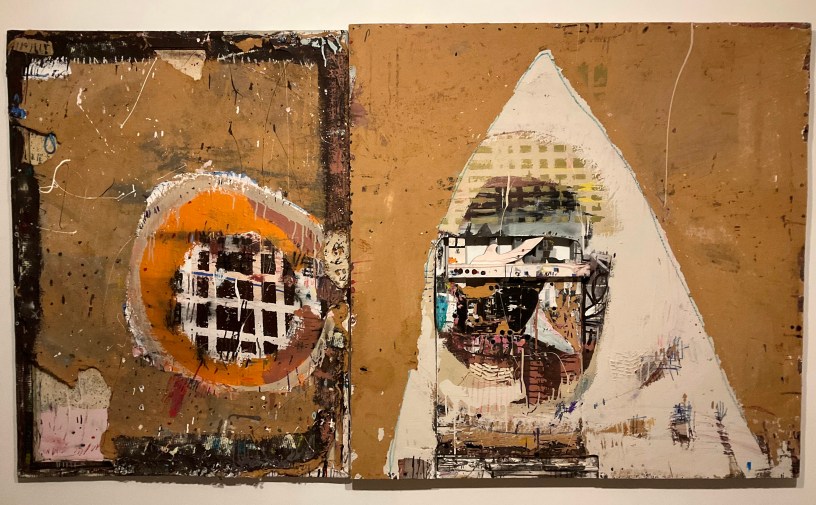
However in the four recent works I discuss here, two key new elements begin to emerge into his oeuvre, both attributable to his move to Nova Scotia. The first of these is evident in the paintings Trojan Moon and The Tower, both shown here. Each of these works is a diptych, comprised of two approximate four foot square wood panels, cut, assembled, reconstituted from found or pre- used or quotidian materials which are then reconfigured using addition, subtraction, gouging, scoring, collaging, painting and mark making.
In this sense these works relate to Austin’s pre Nova Scotia work yet now there is a key difference. His mark- making has generally operated in a territory that hovers between abstraction and figuration however these newer works utilize more explicit figurative and metaphorical imagery. As I have found in my own Painting practice, distance can give a freedom and clarity to an artist’s core project and indeed for Austin, distance from urban life suggests and enables a more direct, if emblematic, reference to the world beyond.

In Trojan Moon. the left hand panel presents a composite of circular / oval marks – the “moon”- with a painted grid interior whilst the right hand panel shows an ambiguous white triangle shape inset with an echo of the “moon” which is inscribed with painted grids, collaged wood and smaller elements suggestive of machinery or circuits. The triangle suggests a human presence via a hood or hat – a symbol diversely used across art history but notably by Goya and Guston. The “grid”, likewise, has a key provenance, specifically in modernist art history. In Trojan Moon, Austin combines and re-presents these references (alongside the titular reference to Greek myth), in metaphoric terms, projecting an underlying sense of disquiet in the contemporary world.

This mood is further referenced in The Tower, again a diptych, where he ascribes the grid more explicitly to urban architecture. Here, the architectural images are fragmented, disjointed as if recalled from memory. The imagery has a blasted, raw feel, moving in an out of depiction and physical realization – the left hand panel contains a painted grid whilst on the right hand panel it is manifested by overlapping strips of wood revealing a void behind where the picture plane has been pierced. Indeed the “ground” on the left hand panel also reveals in the bottom corners a void behind the frame.
There is a sense of peeling walls on the “ground” treatment beyond the grid and in the top left of the right panel, this extends to an amorphous shape piercing it and filled with collaged elements suggestive of urban deitrus. Overall there is a raw, ravaged beauty to these works, and perhaps, to recontextualize Yeats, one might describe them as having a “terrible beauty”.

Concurrent with these works, Austin’s developing Woodland series embodies the second key new element emerging in his Nova Scotia practice. The Woodland series continues his signature use of found and visceral materials to “construct” a painting. However, now surrounded by pristine nature, he utilizes, in these works, the materials of his new rural woodland context to fascinating effect.
Creating an open broadly gridded structure from branches infused with cryptic mark-making, the gridded “architecture” in Woodland Series #1, has now receded to become a central block within that structure reflecting his distance from the city. Constructed from packing case cardboard this emblem of the “urban” is painted with expressive sketch-like mark-making, creating an effect of appearing more distant in his memory.
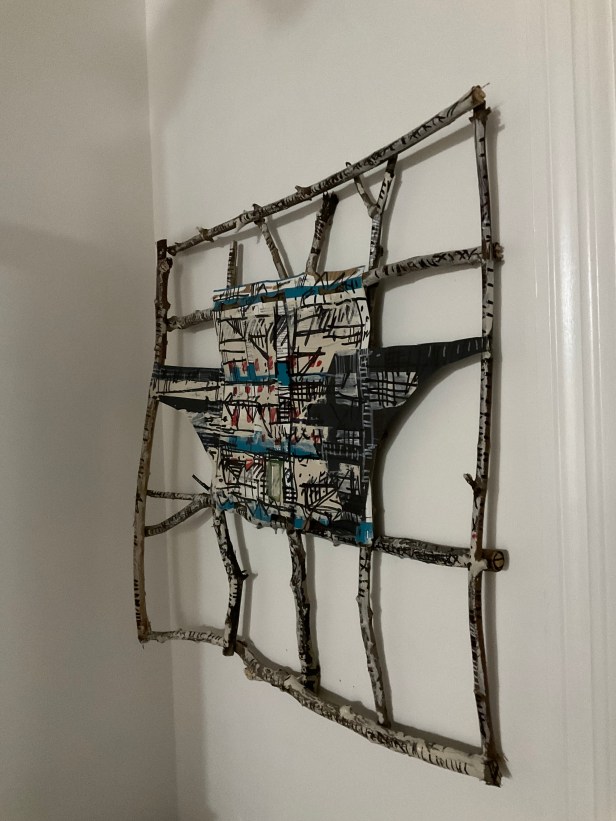
In #2 of the series, the sketch-like painting/drawing on the central block is further fragmented in its suggestions of an urban grid. Indeed in this work there is a sense of an expanding dialogue, perhaps heralding a merger, between the central mark-making and that on the branch structure. The branch structure itself, in fact, reveals itself both literally and metaphorically as a poetic fusion between the geometric and the organic – the geometry of a grid formed with the organic means of the branches complete with their particular idiosyncracies.
With the four works discussed here, we arrive at a fascinating juncture in Austin’s oeuvre. The strength and power of his core approach to making art – imaginative explorations of what Painting can be, rooted in the materiality of his means and processes – is now the underpinning to a practice invigorated by the perspectives and possibilities of his move to Nova Scotia. This promises powerful work to come – and these four works are already testament to that.

Geoffrey Nawn 2024
Writing Copyright: Geoffrey Nawn. All rights reserved.
All Photographs by S.W. Austin. Photographs Copyright: S.W. Austin. All rights reserved.
 THE GEOFFREY NAWN ART BLOG